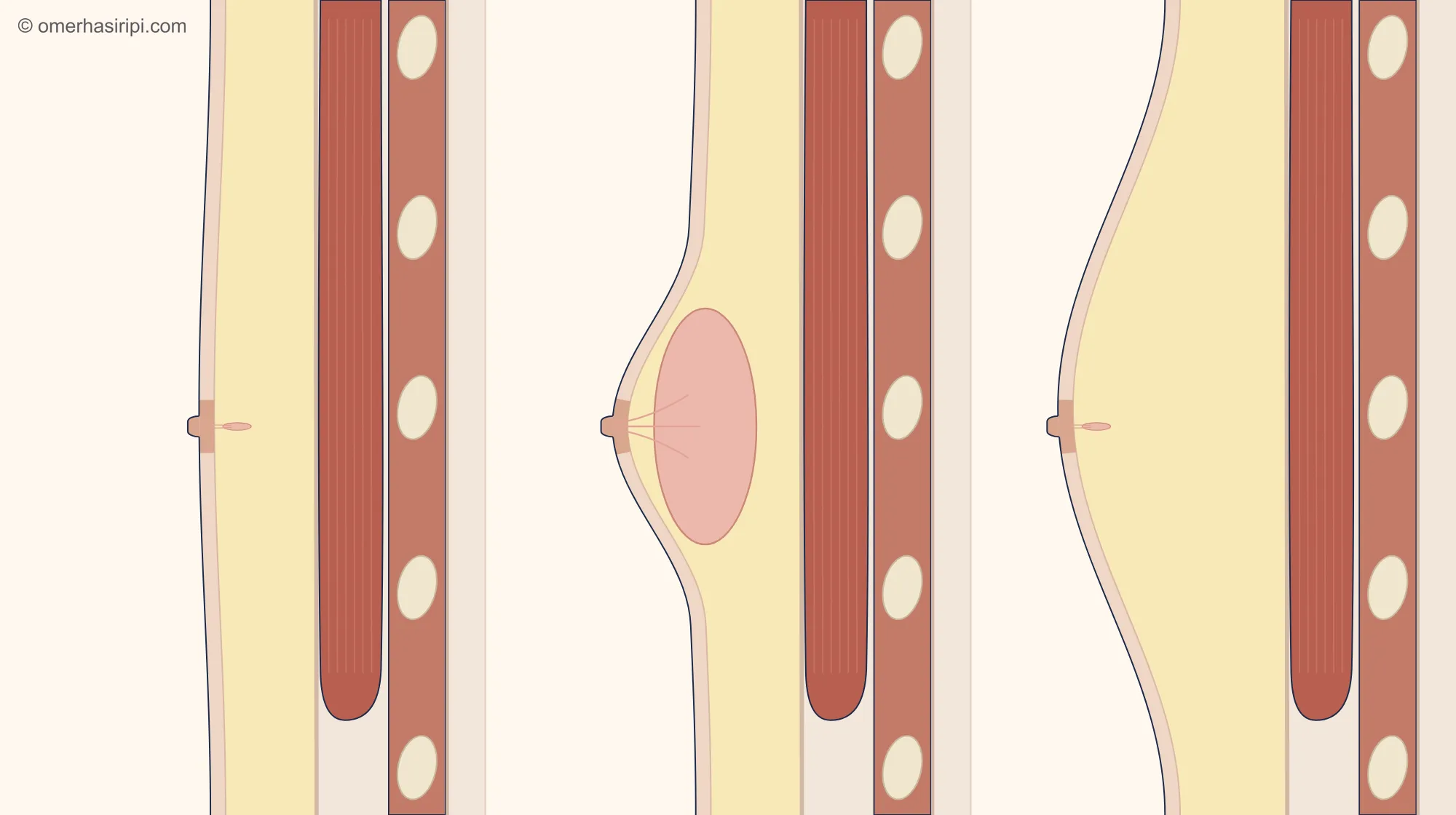
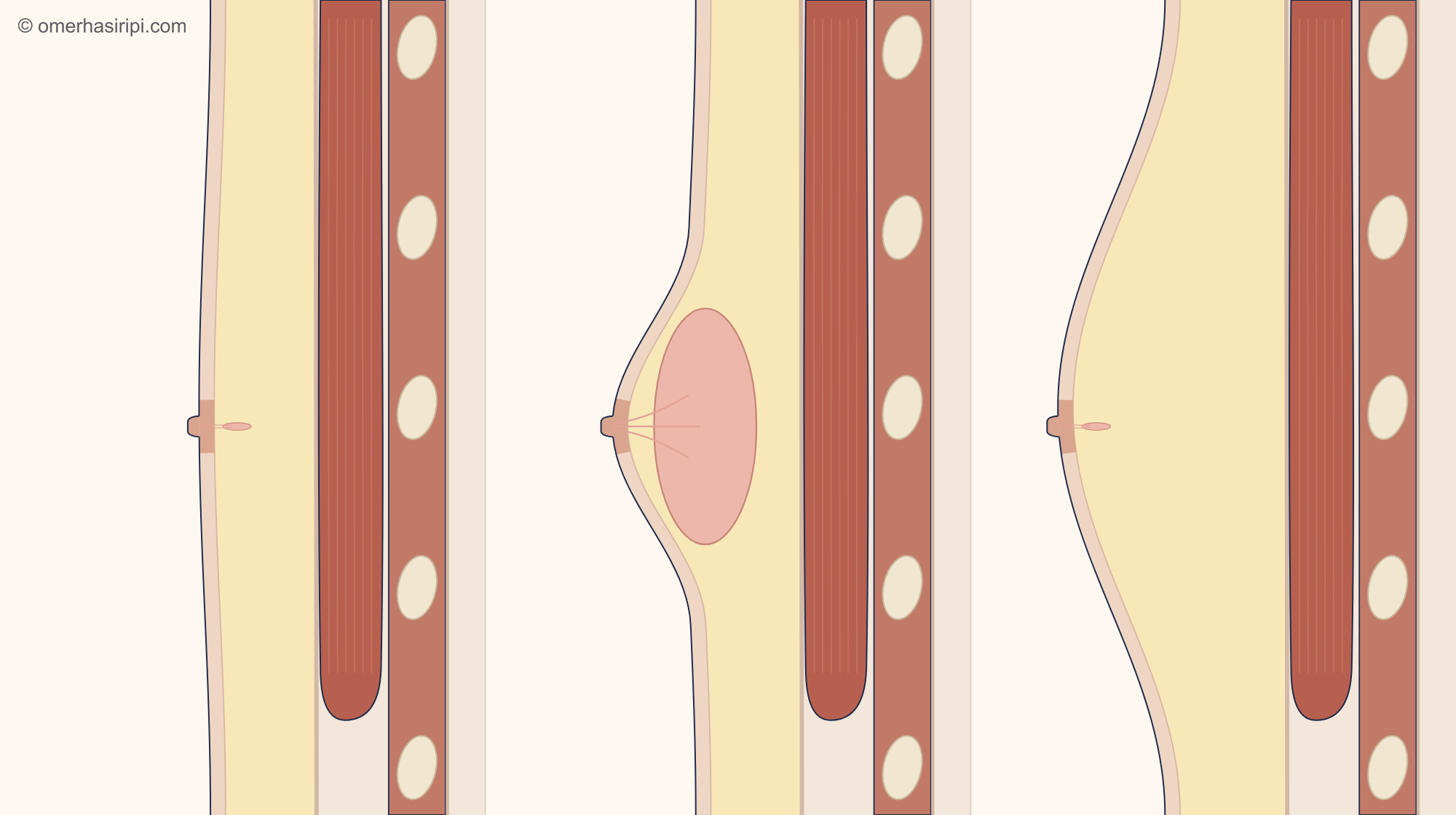
What is gynaecomastia?
Gynaecomastia is benign enlargement of male breast tissue, giving it an appearance similar to a female breast[2]. An enlarged chest caused by increased fat tissue due to excess weight is different from gynaecomastia; this is called pseudogynaecomastia (false gynaecomastia)[6]. Gynaecomastia can also be a mixture of fat and glandular tissue[7]. According to the Italian Society of Andrology and Sexual Medicine (SIAMS) guideline, examination is the basis of diagnosis: a careful examination allows gynaecomastia to be distinguished from an increase in fat and findings suggestive of cancer to be recognised in most patients[1].
It is common: the Türkiye Endokrinoloji ve Metabolizma Derneği (TEMD) guideline gives a frequency of 32 to 65 per cent, depending on age and diagnostic criteria[2]. Frequency peaks three times during life: in infancy, puberty, and middle and older age[2]. It occurs in up to 2 out of 3 men over the age of 50[6].
What causes male breast enlargement?
Gynaecomastia results from an imbalance between the hormones oestrogen and testosterone[6]. According to TEMD, this may arise from an increased effect of oestrogen on the breast, a reduced effect of male hormones (androgens), or a combination of the two[2, 3]. The sources list the following causes:
- hormonal changes during puberty and over the age of 50[5].
- excess weight, obesity or inadequate nutrition[5, 6].
- liver disease (cirrhosis), kidney disease and an overactive thyroid gland[5, 6].
- hormone-secreting tumours are listed among rare causes (SIAMS)[1]; healthdirect gives tumours of the testicles, prostate or adrenal glands as examples[6].
- some genetic conditions, such as Klinefelter syndrome[6].
- some medicines, dietary supplements and substances (also described below)[5, 6].
Body fat produces oestrogen; an increase in oestrogen can cause breast tissue to grow[7]. Testosterone production also decreases with age; more oestrogen and less testosterone can cause the breasts to grow[7]. In some cases, gynaecomastia may be an early sign of hormone-secreting tumours[1]. According to SIAMS, TEMD and healthdirect, no cause is found in about 1 in 4 cases despite a detailed investigation[1, 2, 6].
Which medicines and substances cause breast enlargement in men?
Some types of medicine can cause gynaecomastia by changing the body's hormone balance[7]. The sources mention the following groups of medicines:
- some medicines for high blood pressure and heart conditions; for example, spironolactone[3, 7].
- some medicines used for mental health conditions[7].
- medicines used for stomach ulcers[7].
- medicines containing oestrogen[3].
- medicines used in prostate treatment that suppress testosterone production[3].
- some cancer treatments (such as hormone treatments) and antibiotics[7].
Anabolic steroids used to build muscle can also cause gynaecomastia[7]. According to SIAMS, hormonal substances used for doping, that is, to improve sports performance, have often been associated with gynaecomastia[1]. In a Danish study, alcohol misuse was found to be the second most common risk factor after medicines[1]. Breast Cancer Now says that some herbal supplements and skin care products contain oestrogen and that their effects will stop when they are discontinued[7]. According to one review, for most of the medicines it examined, it is not known whether the medicine actually causes gynaecomastia; the link is assumed, with spironolactone being an exception[15]. This list is not a recommendation to stop taking a prescribed medicine. healthdirect says that avoiding medicines that increase oestrogen levels may help prevent gynaecomastia; you can consult your doctor or pharmacist about this[6].
Does gynaecomastia that starts during puberty go away?
Does gynaecomastia go away on its own?
In adults, duration matters: symptoms such as pain and tenderness may improve within 6 months, but in cases lasting longer than 1 year, spontaneous resolution is rare because the tissue becomes fibrous (fibrotic)[2]. Gynaecomastia that appears after the age of 60, and whose mechanism of development is not fully understood, may not resolve[2]. Most cases do not need treatment; if it is causing a problem, the doctor may recommend treatment directed at the cause, weight loss if you are overweight, medicines that affect hormones in selected cases, or surgery when other methods do not work[1, 2, 3, 5, 6, 7].
What causes breast pain in men?
Gynaecomastia can cause pain and tenderness; in adults, it is more often experienced as nipple sensitivity[2]. Sources give different weight to pain: the American College of Radiology (ACR) says that gynaecomastia is more often painful than cancer[4]; SIAMS lists a firm and tender lump located outside the boundaries of the areola (the dark skin around the nipple) among the signs of cancer in cases affecting one side[1]. The American Cancer Society (ACS) says that a male breast cancer lump is usually, but not always, painless; therefore, having pain does not rule out cancer[8]. See a doctor for pain in the breast or nipple that does not go away[5].
How is gynaecomastia recognised and distinguished from breast cancer?
In gynaecomastia, the lump is most often directly beneath the nipple; it can be felt as a soft, rubbery or firm lump that moves[4]. TEMD lists four typical features: the glandular tissue is central, symmetrical, usually on both sides and tender to the touch in the early growth stage[2]. Male breast cancer, on the other hand, is usually on one side, feels firm and does not move under the skin; it feels irregular and lumpy rather than smooth[6]; according to TEMD, it also grows rapidly[2]. Sources differ on the location of the lump: TEMD says cancer is located off-centre, outside the areola[2]; ACS says the lump is often under or near the nipple or areola[8], healthdirect says it is not always around the nipple[6], and ACR says it may be under the nipple or, unlike gynaecomastia, located off-centre in relation to the nipple[4]. Location alone therefore does not distinguish gynaecomastia from cancer[4, 8]. These features are only a guide; sources describe them as “usually” or “most often” present[6, 8]. Do not try to work out the cause of a lump yourself; always see a doctor[17]. You can find how soon you need to see a doctor in the “When is it an emergency?” box. The National Health Service (NHS) in England says some symptoms of male breast cancer, including lumps, are common and may be caused by other conditions; having symptoms does not definitely mean you have cancer, but it is important to have them checked by a doctor[10]. How a breast lump that can be felt is investigated is explained on the Breast lump page.
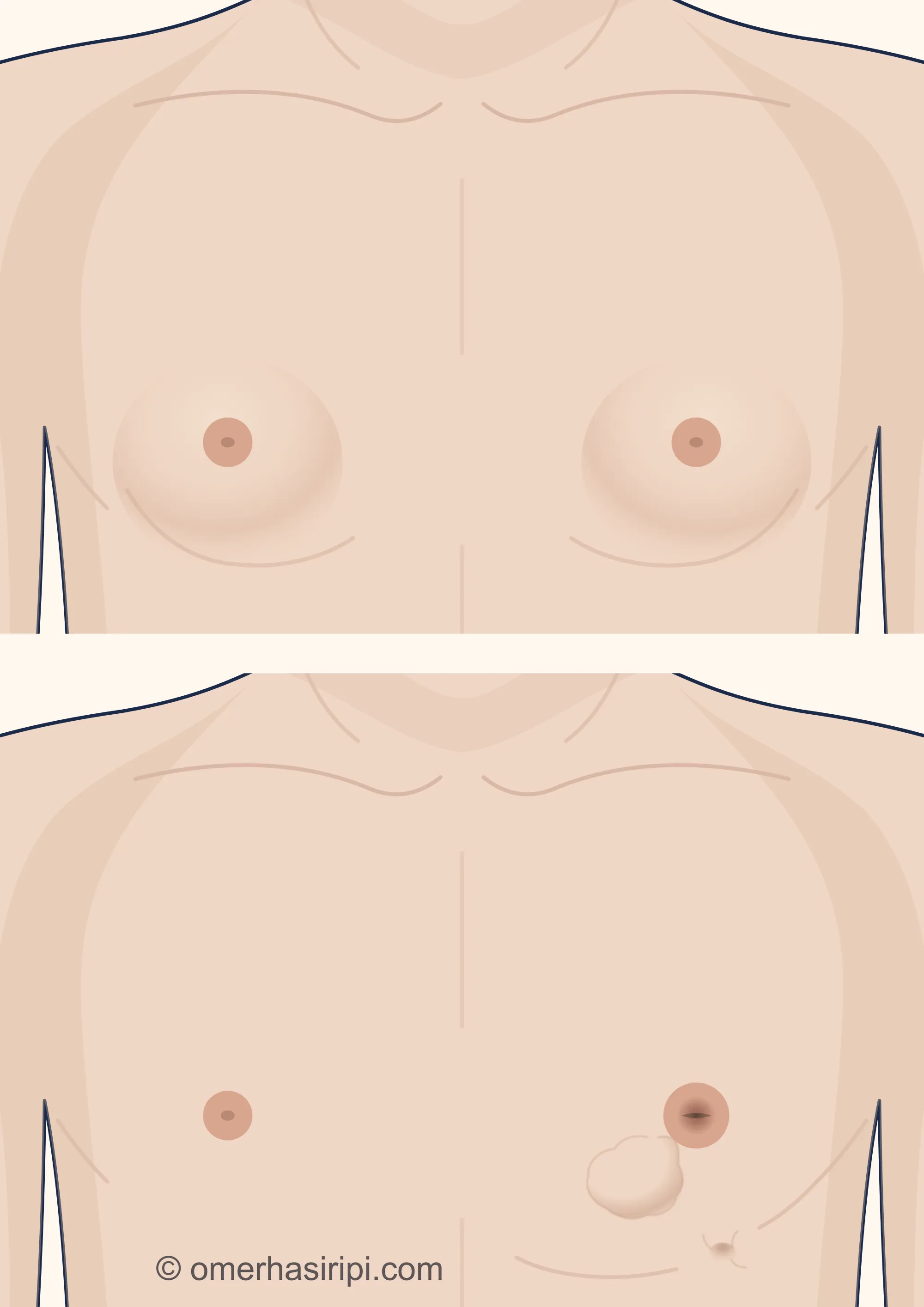
Enlarge
Swipe the drawing right or left to see the details. You can use the arrow keys on your keyboard.
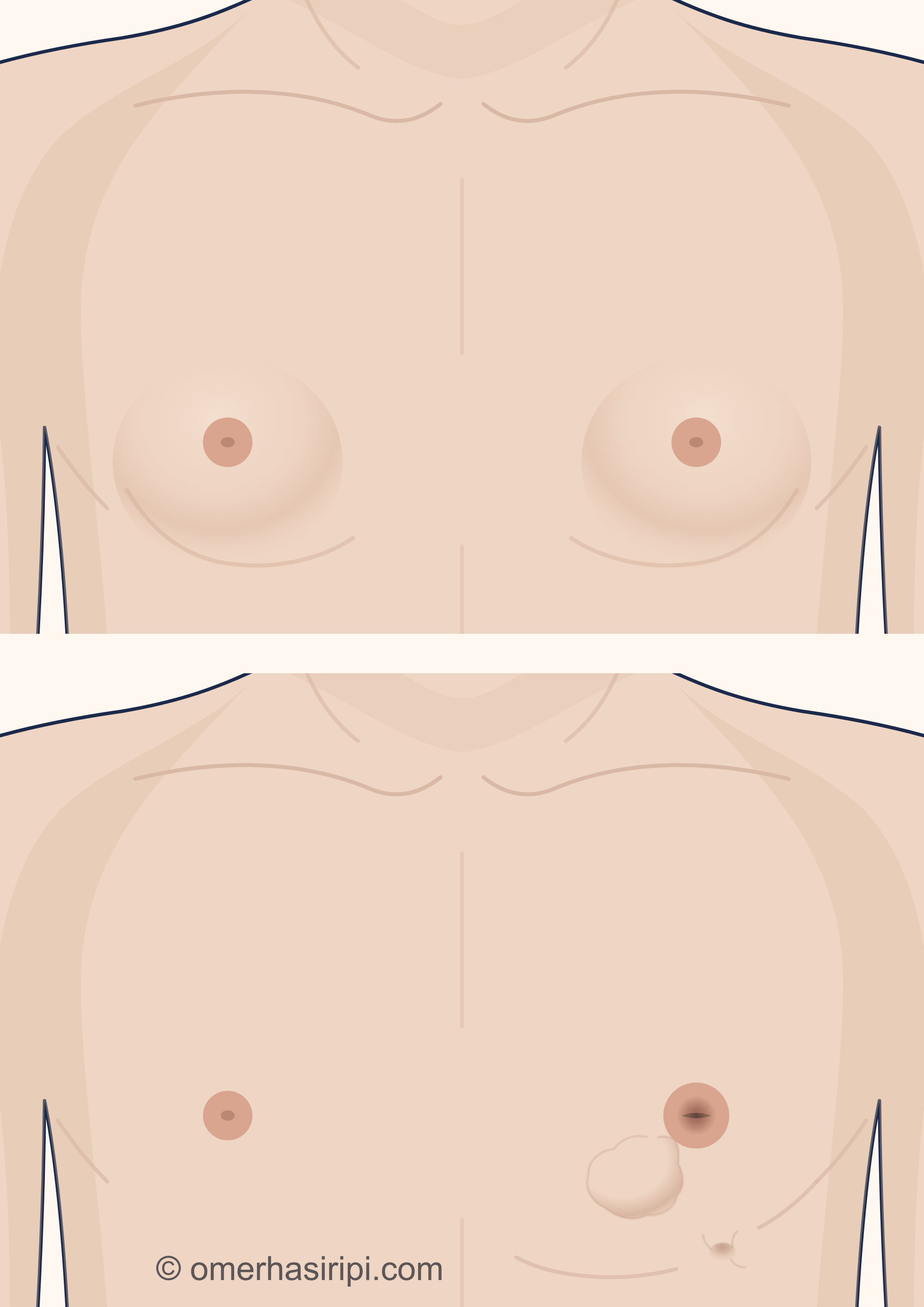
- 1 Central, symmetrical enlargement on both sides, beneath the nipples
- 2 Firm lump on one side
- 3 Nipple turning inwards
- 4 Dimpling of the skin
At the top, typical gynaecomastia: the enlargement is central and symmetrical beneath the nipples in both breasts. At the bottom, some of the signs that should be shown to a doctor immediately: a firm lump on one side, a nipple turning inwards and dimpling of the skin; any one of these can occur on its own. These features are only a guide; the location of the lump alone does not distinguish gynaecomastia from cancer. How soon you should see a doctor is explained in the “When is it an emergency?” box.[2, 4, 6, 8]
Illustrative drawing, not to scale. Prepared for this site.
Does gynaecomastia increase the risk of breast cancer?
Breast cancer in men is rare; around 1% of breast cancers occur in men[13]. TEMD, ACR, healthdirect and Breast Cancer Now state that gynaecomastia does not increase the risk of breast cancer or is not believed to be a risk factor[2, 4, 6, 7]. A review also says that gynaecomastia was not a significant risk factor in most studies[14]. In contrast, a review published in 2025 in Deutsches Ärzteblatt, a German journal for doctors, reports that gynaecomastia is associated with a higher risk of breast cancer[13]. Men with Klinefelter syndrome have a higher risk of breast cancer[1, 2, 9, 11]. TEMD puts this increase at 20 to 60 times, but states that the risk is still considerably lower than in women[2]. If you have Klinefelter syndrome, discuss with your doctor how your breasts will be monitored: the SIAMS guideline recommends a breast examination once a year; TEMD does not recommend routine mammogram screening[1, 2]. Breast Cancer Now says it is important to be breast aware even if you have gynaecomastia, and to return to your doctor if you notice another change, however soon after diagnosis it occurs[7].
When should you see a doctor about gynaecomastia?
healthdirect states that gynaecomastia is usually not serious, but that it is important to see a doctor to find the cause[6]. See a doctor if the size or appearance of your breast worries you or if the condition makes you feel embarrassed[5, 7]. Return to your doctor if the tissue grows, becomes painful or a new symptom appears[7]. TEMD’s patient page says that underlying causes should be carefully investigated when enlargement is new, grows rapidly, exceeds 5 cm, or is painful or tender[3]. The guideline from England’s National Institute for Health and Care Excellence (NICE) tells doctors to consider referring men with a painless enlargement of a testicle or a change in its shape or texture for rapid specialist assessment for suspected cancer[12]. This guideline was written for people with symptoms that raise suspicion of cancer, not for gynaecomastia[12].
Which doctor should you see for gynaecomastia?
The first step is to talk to a doctor[6]. Breast Cancer Now states that the doctor will assess your symptoms and may refer you to a breast clinic if necessary[7]. TEMD’s patient page states that an appropriate assessment will be made if you consult a specialist in endocrinology and metabolic diseases[3]. The doctor will examine you and ask about your symptoms and the medicines you take[6]. If necessary, the doctor may request blood tests, imaging such as ultrasound or a mammogram, and a tissue sample (biopsy)[6].
Sources
17
- Pozza C, Selice R, Barbonetti A, Hasenmajer V, Lotti F, Menafra D, et al. Management of gynecomastia in adolescence and adults: the clinical practice guidelines from the Italian Society of Andrology and Sexual Medicine (SIAMS). J Endocrinol Invest. 2026;49(10):2583–2610. (Full text read. Accessed: 5 October 2026.) doi: 10.1007/s40618-026-02915-2. PubMed: 42258023.
- Türkiye Endokrinoloji ve Metabolizma Derneği (TEMD). Adrenal ve Gonadal Hastalıklar Kılavuzu 2025, Bölüm 17: Jinekomasti (printed pp. 286–296; p. 296 is the bibliography). ISBN 978-625-99759-5-5. (Only this chapter was read. Accessed: 5 October 2026.) Text: file.temd.org.tr.
- Türkiye Endokrinoloji ve Metabolizma Derneği (TEMD). Jinekomasti (memelerde büyüme): patient information page. The page does not state its own date (footer: 2025). Accessed: 5 October 2026. Text: temd.org.tr.
- Expert Panel on Breast Imaging; Niell BL, Lourenco AP, Moy L, Baron P, Didwania AD, diFlorio-Alexander RM, et al. ACR Appropriateness Criteria® Evaluation of the Symptomatic Male Breast. J Am Coll Radiol. 2018;15(11S):S313–S320. (The ACR narrative text was read; table ratings were not used. Accessed: 5 October 2026.) doi: 10.1016/j.jacr.2018.09.017. PubMed: 30392600.
- NHS (United Kingdom National Health Service). Gynaecomastia (gynaecomastia): patient information page. Last reviewed: 31 May 2024. Accessed: 5 October 2026. Text: www.nhs.uk.
- healthdirect Australia. Gynaecomastia (gynaecomastia): patient information page. Last reviewed: May 2025. Accessed: 5 October 2026. Text: www.healthdirect.gov.au.
- Breast Cancer Now (breast cancer charity in England). Gynaecomastia (gynaecomastia): patient information page. Last reviewed: January 2024. Accessed: 6 October 2026. Text: breastcancernow.org.
- American Cancer Society (American Cancer Society). Signs and Symptoms of Breast Cancer in Men (signs of breast cancer in men). Last updated: 15 October 2025. Accessed: 6 October 2026. Text: www.cancer.org.
- American Cancer Society (American Cancer Society). Causes, Risk Factors, and Prevention of Breast Cancer in Men (causes and risk factors for breast cancer in men). Last updated: 15 October 2025. Accessed: 6 October 2026. Text: www.cancer.org.
- NHS (United Kingdom National Health Service). Symptoms of breast cancer in men (signs of breast cancer in men): patient information page. Last reviewed: 24 March 2024. Accessed: 6 October 2026. Text: www.nhs.uk.
- NHS (United Kingdom National Health Service). Klinefelter syndrome (Klinefelter syndrome): patient information page. Last reviewed: 20 February 2023; the page’s own next review date (20 February 2026) has passed. Accessed: 5 October 2026. Text: www.nhs.uk.
- National Institute for Health and Care Excellence (NICE). Suspected cancer: recognition and referral (NICE guideline NG12). Published: 23 June 2015; last updated: 15 April 2026. The testicular cancer recommendations (1.6.7, 1.6.8) date from 2015; the guideline was written for people in general, not specifically for gynaecomastia. Accessed: 6 October 2026. Text: www.nice.org.uk.
- Faridi A, Gerber B, Hartmann S. Diseases of the Male Breast: Gynecomastia and Breast Cancer. Dtsch Arztebl Int. 2025;122(15):406–411. (Narrative review for doctors, not a guideline. Full text read on the PMC webpage; Europe PMC does not list the article as open access. Accessed: 6 October 2026.) doi: 10.3238/arztebl.m2025.0071. PubMed: 40331995.
- Fentiman IS. Risk factors for male breast cancer. Am J Transl Res. 2023;15(12):6918–6925. (Narrative review, not a guideline. Full text read on the PMC webpage; Europe PMC does not list the article as open access; DOI omitted because it could not be verified. Accessed: 6 October 2026.) PubMed: 38186995.
- Nuttall FQ, Warrier RS, Gannon MC. Gynecomastia and drugs: a critical evaluation of the literature. Eur J Clin Pharmacol. 2015;71(5):569–578. (Literature review; not a guideline. Accessed: 6 October 2026.) doi: 10.1007/s00228-015-1835-x. PubMed: 25827472.
- NHS (United Kingdom National Health Service). Symptoms of testicular cancer (signs of testicular cancer): patient information page. Last reviewed: 2 April 2024. Accessed: 6 October 2026. Text: www.nhs.uk.
- NHS (United Kingdom National Health Service). Breast lumps (breast lump): patient information page; not written specifically for men. Last reviewed: 28 June 2023; the page’s own next review date (28 June 2026) has passed. Accessed: 6 October 2026. Text: www.nhs.uk.
Medical review of the Turkish original: Op. Dr. Ömer Seyfullah Hasıripi, . This page is a translation checked by AI reviewers; the Turkish version prevails.
This page is for general information; it does not replace an examination. See a doctor about your symptoms.