
What are the symptoms of breast cancer?
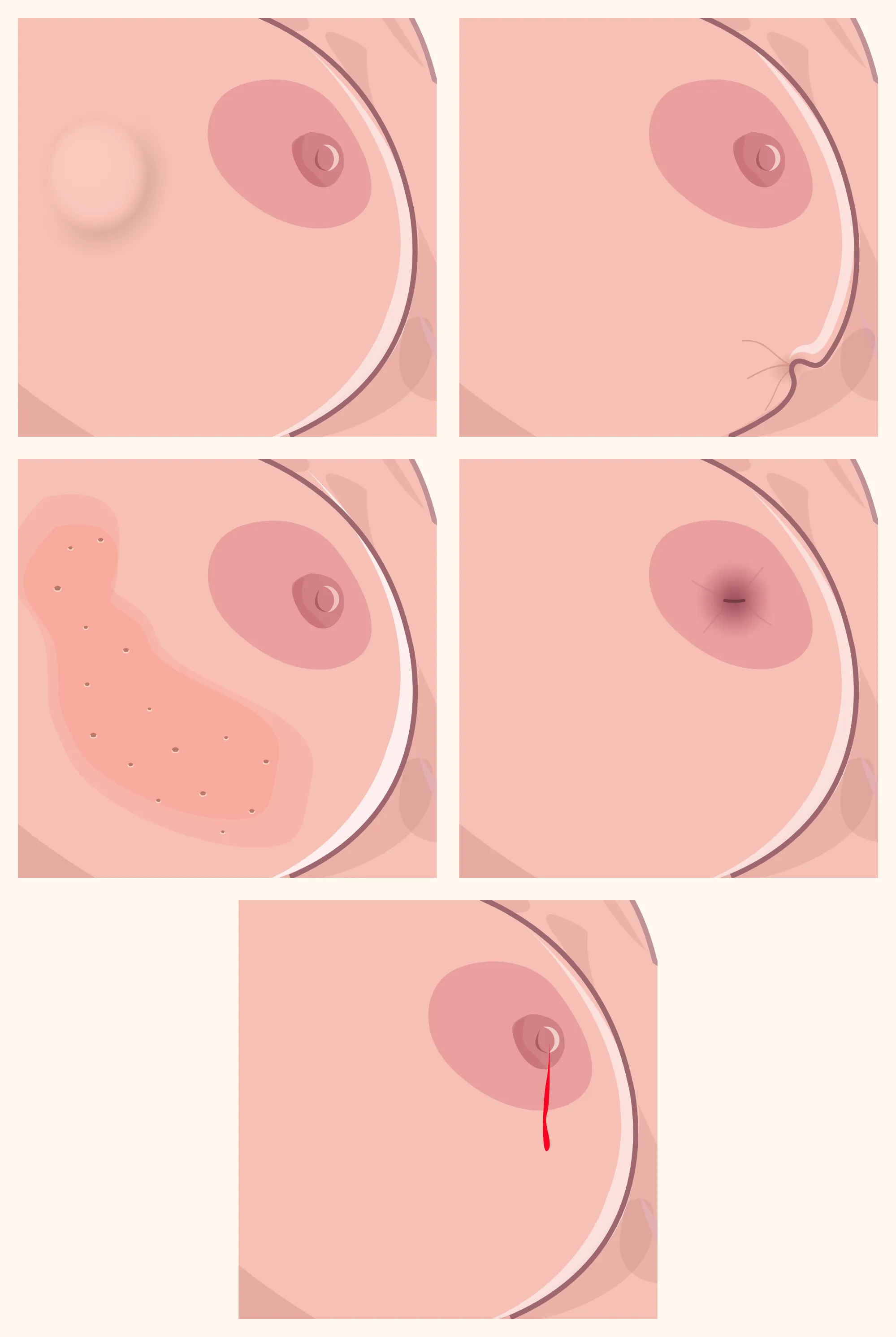
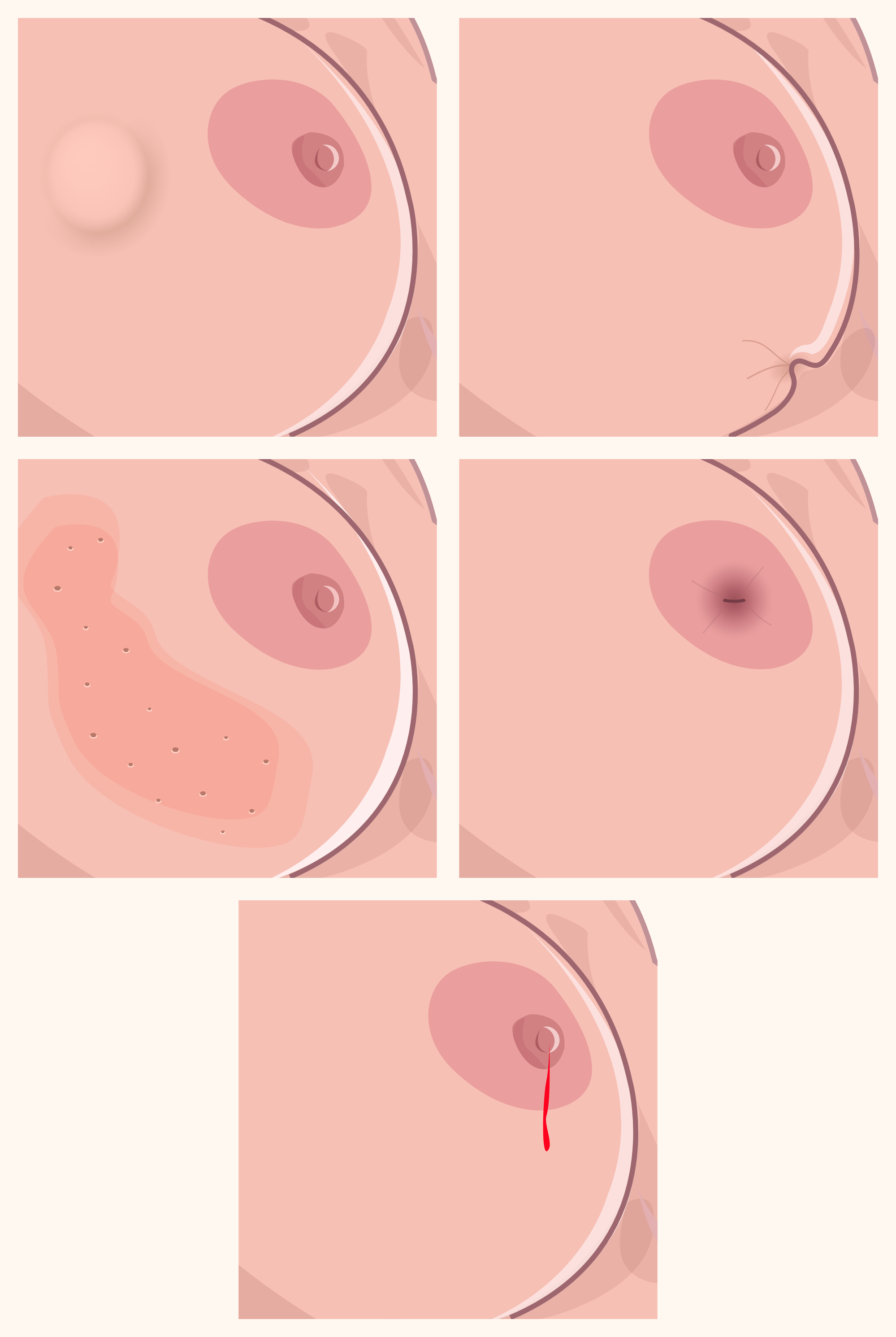
One of the most common symptoms of breast cancer is a lump in the breast that is usually painless and may grow over time[6]. The Turkish Ministry of Health and the National Health Service in England (NHS) list the following changes as symptoms[5, 6]:
- A lump or swelling in the breast, chest or armpit, or around the collarbone[5, 6].
- A noticeable change in the shape or size of the breast[5, 6].
- Thickening, redness, dimpling or an orange-peel appearance of the breast skin; a change in skin colour (it may look darker than usual on brown and black skin and red on white skin)[5, 6].
- A nipple turning inwards, crusting or a rash resembling eczema[5, 6].
- Discharge from the nipple other than milk, especially bloody discharge that comes out on its own[4, 6].
Breast cancer may cause no symptoms in its early stages; according to the US National Cancer Institute (NCI), this is why screening is important[4, 6].
Does breast cancer cause pain?
These symptoms can occur without pain; breast pain on its own is not usually a symptom of breast cancer[5]. See a doctor if you have pain in your breast or armpit and people in your family have had breast or ovarian cancer[5]. England’s screening leaflet says it is best to have pain checked if it is present all or almost all the time in the breast or armpit, and says to see a doctor the same day for the symptoms in this section[2]; the NHS breast pain page and the NCI say to see a doctor if pain does not go away or improve[3, 4].
Can redness and swelling of the breast be a sign of cancer?
Inflammatory breast cancer is a rare and aggressive type of breast cancer in which cancer cells block the lymph vessels in the skin; the breast looks inflamed[1]. It accounts for 1–5% of all breast cancers; it often does not cause a lump and may not show up on a mammogram[1]. Most symptoms develop quite quickly, over a few weeks to months: swelling of the skin, redness over at least one third of the breast, thickening of the skin like orange peel, one breast being larger, warmer and heavier than the other, and swollen lymph nodes in the armpit or near the collarbone[1]. These symptoms can also have other causes; nevertheless, see a doctor the same day to have them checked[1, 2]. The doctor may first suspect an infection and prescribe antibiotics; if the symptoms get worse, the affected area grows or the symptoms do not improve within about a week, be sure to tell the doctor[1]. The NHS mastitis page says to see a doctor if symptoms do not improve 48 hours after starting antibiotics[9].
How quickly should I see a doctor?
Sources do not use the same words to describe how quickly to see a doctor when you notice a change in your breast[2, 3, 5, 6]. The Turkish Ministry of Health says that symptoms may be a sign of breast cancer and that you should go to a healthcare facility without delay[6]. The NHS patient page says to see a doctor for a lump or swelling in the breast or an unusual change in the breast or nipple, under the heading “Non-urgent advice”; England’s screening leaflet says to speak to a doctor as soon as possible and ask for an urgent appointment for the symptoms on its list[2, 5]. The NHS breast pain page asks you to seek an urgent appointment (see a doctor the same day) for a hard lump that does not move or a red, hot or swollen breast[3].
What are the risk factors for breast cancer, and who is at greater risk?
Breast cancer mostly affects women aged 45 and over, but it can occur in anyone with breasts; after being a woman, age is the most important risk factor[10, 11]. Breast cancer is the most common cancer in women in Turkey: according to the Turkish Ministry of Health’s 2022 cancer statistics, about one in every three cancer diagnoses in women is breast cancer, and half of women diagnosed with breast cancer are aged 54 or younger[12]. The Turkish Ministry of Health lists older age, a family history of breast cancer, an inherited change in genes such as BRCA1 and BRCA2 that is known to increase risk, dense breast tissue, excess weight especially after menopause, and alcohol and tobacco use among the risk factors[6, 11]. A woman’s risk nearly doubles if a first-degree relative, such as her mother, sister or daughter, has breast cancer; if two first-degree relatives have breast cancer, the risk may triple[13]. Breast cancer in a father or brother also increases the risk[13]. According to the American Cancer Society (ACS), changes in the BRCA1 and BRCA2 genes cause hereditary breast and ovarian cancer syndrome; a woman carrying such a change known to increase risk has, on average, up to a 70 in 100 chance of being diagnosed with breast cancer during her lifetime[13, 14]. If there is breast or ovarian cancer in your family, talk to your doctor.
How is breast cancer screening done, and at what age is a mammogram taken?
According to the Turkish Ministry of Health, women aged 40–69 can have free mammogram screening every two years[6]. The Turkish Radiology Society (TRD) guideline reports the Ministry’s standard (a mammogram every two years at ages 40–69), but its own recommendation is an annual mammogram starting at age 40[15].
Where is breast cancer screening carried out?
Screening is free as part of primary healthcare services at Cancer Early Diagnosis, Screening and Training Centres (KETEM), Healthy Life Centres, Community Health Centres, Family Health Centres and mobile cancer screening vehicles[6].
Can a breast examination replace screening?
The Ministry recommends that women examine their own breasts from age 20 and be aware of changes in their breasts[6]. The ACS does not recommend clinical breast examination (an examination by a healthcare professional) for screening at any age in women at average risk; it asks everyone to know how their breasts normally look and feel and to report changes immediately. The NCI says that a clinical examination or self-examination alone is not an adequate screening test[14, 16]. The Ministry recommends a clinical breast examination every two years between ages 20 and 39[17, 18]. Turkish Ministry of Health texts recommend an annual clinical breast examination after age 40[6, 17, 18, 19].
How is breast cancer screening carried out in other countries?
Guidelines differ on the age to start screening, how often to screen and the age to stop[20]:
- US Preventive Services Task Force (USPSTF, 2024): recommends a mammogram every two years at ages 40–74; the recommendation does not cover high-risk genetic conditions such as BRCA, high-dose chest radiotherapy at a young age, previous breast cancer or a high-risk breast lesion on a previous biopsy[21].
- ACS, for women at average risk: women aged 40–44 who wish to can start annual screening; annual screening is recommended at ages 45–54; from age 55, screening can be done every two years or annually[14].
- European Commission Initiative on Breast Cancer (ECIBC), for women without symptoms and at average risk: makes a strong recommendation for mammography at ages 50–69; makes a conditional recommendation at ages 45–49 and 70–74, and conditionally recommends against screening at ages 40–44 (all four in the context of an organised screening programme)[22].
Mammogram screening ages according to guidelines
- Recommended
- Optional or conditional recommendation
- Recommended against (conditional)
- no upper age limit
-
Turkey, Turkish Ministry of Health [6]
Ages 40–69: every two years (free screening)
-
Turkish Radiology Society [15]
Every year from age 40; no upper age limit, stopping is recommended if life expectancy is less than 5 years
-
US Preventive Services Task Force (USPSTF, 2024) [21]
Ages 40–74: every two years
-
USA, American Cancer Society (ACS) [14]
Ages 40–44: those who wish to can start annual screening · Ages 45–54: every year · Age 55 and over: every two years or every year, as long as the woman is healthy and expected to live at least 10 more years
-
European Commission Initiative on Breast Cancer (ECIBC) [22]
All within an organised screening programme: ages 40–44: conditional recommendation against screening · Ages 45–49: conditional recommendation · Ages 50–69: strong recommendation · Ages 70–74: conditional recommendation
Show as a table
| Guideline | Age and frequency |
|---|---|
| Turkey, Turkish Ministry of Health [6] | Ages 40–69: every two years (free screening) |
| Turkish Radiology Society [15] | Every year from age 40; no upper age limit, stopping is recommended if life expectancy is less than 5 years |
| US Preventive Services Task Force (USPSTF, 2024) [21] | Ages 40–74: every two years |
| USA, American Cancer Society (ACS) [14] | Ages 40–44: those who wish to can start annual screening · Ages 45–54: every year · Age 55 and over: every two years or every year, as long as the woman is healthy and expected to live at least 10 more years |
| European Commission Initiative on Breast Cancer (ECIBC) [22] | All within an organised screening programme: ages 40–44: conditional recommendation against screening · Ages 45–49: conditional recommendation · Ages 50–69: strong recommendation · Ages 70–74: conditional recommendation |
What can breast cancer screening do, and what can it not do?
According to the American College of Radiology (ACR), published guidelines agree that regular screening reduces illness and deaths due to breast cancer[20]. Of every 100 people screened in England, 96 will not need another test and 4 will need further tests; 1 of these 4 people is diagnosed with breast cancer[2]. Being called back for further imaging and eventually found to have a benign result is called a false positive; in Germany’s screening programme, about 24% of participants are called back in this way an average of once over 20 years of screening[23]. A mammogram uses a small amount of radiation; this increases the lifetime chance of developing cancer by a very small amount[2]. A screening mammogram does not find every breast cancer; such results are called false negatives[14], and false-negative results are more common in women with dense breast tissue[16]. England’s screening leaflet says that very rarely a cancer may be missed and cancer can also develop between two screenings[2]; even after a normal result, contact your doctor if you notice a new change[4].
- 96 people: no further test needed after this screening
- 4 people: further tests needed
- 1 of these 4 people: diagnosed with breast cancer
Is screening different for women at high risk?
The ACS recommends both MRI (magnetic resonance imaging) and a mammogram every year for women at high risk, usually starting at age 30. These include women whose lifetime risk is about 20–25% or higher according to risk assessment tools based mainly on family history, those found by genetic testing to have a BRCA1 or BRCA2 change known to increase risk, and those who had chest radiotherapy before age 30[14]. The ACS asks that this decision be made together with the healthcare team[14]. The TRD guideline recommends starting MRI screening at age 25 in carriers of a BRCA gene mutation and adding it to mammography after age 30; it reports that, in BRCA1 carriers under 40, the additional benefit of mammography may be positive or negative when cumulative radiation is taken into account[15].
Can men get breast cancer?
Yes, but it is rare: according to the Turkish Ministry of Health’s 2022 cancer statistics, about 1 in 100 breast cancers in Turkey occur in men (an estimated 312 men and 32,021 women in one year)[12]; in men, it usually appears at an older age than in women[24]. The most common symptom is a lump, often under or near the nipple, that is usually (but not always) hard and painless[8]. According to the ACS, screening all men with mammograms or other tests is unlikely to be beneficial; most breast cancers in men are found because of symptoms[25]. Sources differ for men at increased risk: the NCI does not usually recommend screening mammograms even in these men, but says a doctor may recommend regular clinical examinations[24]; the ACS says careful breast examinations may be useful, but the benefit of screening has not been studied[25]; the ACR considers screening mammograms usually appropriate, but data are limited. Under age 25, it does not usually consider screening with imaging appropriate regardless of risk (as distinct from an examination prompted by symptoms)[26].
What changes during pregnancy, breastfeeding and at different ages?
During pregnancy and breastfeeding
According to the NCI, breast cancer diagnosed during pregnancy, within one year after giving birth or while breastfeeding is called pregnancy-associated breast cancer; it occurs in about 1 in 3,000 pregnancies, most often at ages 32–38[27]. The ACR uses pregnancy and the 12 months after giving birth in its definition and gives the frequency as 1 in 3,000 to 10,000 pregnancies[28]. According to the ACR, most breast problems that occur during pregnancy are benign; but the signs of cancer are non-specific and may delay diagnosis[28]. The NCI recommends clinical breast examinations for pregnant and breastfeeding women at antenatal and postnatal check-ups and asks them to speak to a doctor immediately about a worrying change[27].
In younger women
The German guideline says that women under 40 who have healthy breasts, no symptoms and a low or moderate risk (moderate risk according to the guideline: a 17–29% lifetime risk of breast cancer) should not be screened with mammograms[23]. Women who have previously had breast cancer are excluded from this recommendation: rather than enrolling them in the screening programme offered every two years, the same guideline recommends following them in post-cancer care, usually with a mammogram every year, and discussing the follow-up plan with them[23].
After what age are mammograms no longer taken?
The Ministry’s free screening covers ages 40–69; according to the TRD, there is no upper age limit for screening, but stopping is recommended if life expectancy is less than 5 years[6, 15]. The ACS recommends that screening continue as long as a woman is healthy and expected to live at least 10 more years; in England, women aged 71 and over are not automatically invited, but those who wish to can have screening every three years[2, 14].
How is breast cancer treated?
A team plans treatment: according to the Turkish Ministry of Health’s Turkey Cancer Control Programme, the approach to breast cancer should be decided by a tumour board that includes a general surgeon, medical oncologist, radiation oncologist, radiologist and pathologist; additional treatments after surgery are also recommended by the board according to the pathology result[29]. Surgery may involve removing only the cancerous area (breast-conserving surgery), removing the whole breast (mastectomy) and removing lymph nodes in the armpit; the type depends on the size of the cancer and whether it has spread[30]. Nearby lymph nodes are most often checked with a sentinel lymph node biopsy[31]. Other common treatments include chemotherapy, radiotherapy, hormone therapy, targeted medicines and immunotherapy; which treatment is used depends on the size and type of the cancer and whether it has spread[30].
Sources
32
- American Cancer Society (ACS). Inflammatory Breast Cancer (inflammatory breast cancer): patient information page. Last reviewed: 24 June 2026. Accessed: 5 October 2026. Text: www.cancer.org.
- NHS England / GOV.UK. Your guide to NHS breast screening (NHS breast screening guide): patient leaflet for women in England. Updated: 23 February 2026. Accessed: 5 October 2026. Text: www.gov.uk.
- NHS (National Health Service in England). Breast pain (breast pain): patient information page. Last reviewed: 3 May 2023; the page’s own next review date (3 May 2026) has passed. Accessed: 28 September 2026; the relevant item was reread on the live page on 6 October 2026. For England only: the directions (GP, NHS 111) relate to the health service in England. Text: www.nhs.uk.
- National Cancer Institute (NCI, US National Cancer Institute). Breast Cancer Signs and Symptoms (breast cancer signs and symptoms): patient information page. Published: 2 December 2025. Accessed: 5 October 2026. Text: www.cancer.gov.
- NHS (National Health Service in England). Symptoms of breast cancer in women (breast cancer symptoms in women): patient information page. Last reviewed: 4 March 2024. Accessed: 5 October 2026. For England only: the directions on the page (GP, NHS 111) relate to the health service in England. Text: www.nhs.uk.
- Turkish Ministry of Health, Directorate General of Public Health, Department of Cancer. 1-31 Ekim Meme Kanseri Farkındalık Ayı (the address ends in “…ayi-2.html”). No date on the page. Accessed: 5 October 2026. The standard itself could not be read because the Ministry’s “Ulusal Meme Kanseri Tarama Standartları” page could not be opened (HTTP 404); the standard is given as reported on this page. This page states that a clinical breast examination should be performed annually from age 20; this page is based on the Ministry’s texts stating every two years for ages 20–39 (doctor’s decision). Text: hsgm.saglik.gov.tr.
- NHS (National Health Service in England). Symptoms of breast cancer in men (breast cancer symptoms in men): patient information page. Last reviewed: 24 March 2024. Accessed: 5 October 2026. For England only: the directions relate to the health service in England. Text: www.nhs.uk.
- American Cancer Society (ACS). Signs and Symptoms of Breast Cancer in Men (breast cancer symptoms in men): patient information page. Last reviewed: 15 October 2025. Accessed: 5 October 2026. Text: www.cancer.org.
- NHS (National Health Service in England). Mastitis (mastitis): patient information page. Last reviewed: 17 March 2023; the page’s own next review date (17 March 2026) has passed. Accessed: 6 October 2026. For England only: the directions (GP) relate to the health service in England. Text: www.nhs.uk.
- National Cancer Institute (NCI). What Is Breast Cancer? (what is breast cancer?): patient information page. Updated: 2 December 2025. Accessed: 5 October 2026. Text: www.cancer.gov.
- National Cancer Institute (NCI). Breast Cancer Causes and Risk Factors (breast cancer causes and risk factors): patient information page. Updated: 2 December 2025. Accessed: 5 October 2026. Text: www.cancer.gov.
- Turkish Ministry of Health, Directorate General of Public Health, Department of Cancer. Türkiye Kanser İstatistikleri 2022. Ankara, 2026. Table 6 (printed p. 15) and breast cancer section (printed p. 38). The figures are the report’s own estimates (2022 coverage 47.3 per cent). Accessed: 22 October 2026. Text: hsgm.saglik.gov.tr.
- American Cancer Society (ACS). Breast Cancer Risk Factors You Cannot Change (breast cancer risk factors that cannot be changed): patient information page. Last reviewed: 24 March 2026. Accessed: 5 October 2026. Text: www.cancer.org.
- American Cancer Society (ACS). American Cancer Society Recommendations for the Early Detection of Breast Cancer (ACS recommendations for the early detection of breast cancer). Last reviewed: 23 July 2026. Accessed: 5 October 2026. Text: www.cancer.org.
- Türk Radyoloji Derneği. Meme Kanseri Tarama Rehberi. Three-page PDF; no publication date is given in the document; “2021” is the creation date in the PDF file properties (20 October 2021); the most recent publication in the bibliography is from 2018. A professional guideline written for radiologists; it reports the Ministry’s screening standard (the standard itself could not be read). Text: www.turkrad.org.tr.
- National Cancer Institute (NCI). Breast Cancer Screening (breast cancer screening): patient information page. Updated: 2 December 2025. Accessed: 5 October 2026. Text: www.cancer.gov.
- Turkish Ministry of Health, Directorate General of Public Health, Department of Cancer. 1-31 Ekim Meme Kanseri Farkındalık Ayı (a page with the same title; its address ends in “…ayi.html”). No date on the page. Accessed: 5 October 2026. Text: hsgm.saglik.gov.tr.
- Turkish Ministry of Health, Directorate General of Public Health, Department of Cancer. Breast cancer leaflet (file title “BROŞÜR ARKA”, two-page PDF, created in October 2023). Only the text layer of this PDF was read; if the leaflet has another side, it was not read. Accessed: 5 October 2026. Text: hsgm.saglik.gov.tr.
- Turkish Ministry of Health, Directorate General of Public Health, Department of Cancer. ‘Ekim’ Meme Kanseri Farkındalık Ayı (another page from the same directorate; its address ends in “…/ekim-meme-kanseri-farkindalik-ayi.html”, and its title gives “Ekim” in quotation marks). No date on the page; the footer states “Copyright © 2025”. Accessed: 6 October 2026. Text: hsgm.saglik.gov.tr.
- Expert Panel on Breast Imaging: Yeh ED, Brown A, Freer PE, Bahl M, Bennett DL, et al. ACR Appropriateness Criteria® Female Breast Cancer Screening: 2025 Update. J Am Coll Radiol. 2025;22(11S):S508–S530. (The ACR’s free narrative PDF was read.) doi: 10.1016/j.jacr.2025.08.044. PubMed: 41193041.
- US Preventive Services Task Force (USPSTF); Nicholson WK, Silverstein M, Wong JB, et al. Screening for breast cancer: US Preventive Services Task Force recommendation statement. JAMA. 2024;331(22):1918–1930. The full JAMA text was not read; the full recommendation text on the USPSTF’s official website (dated 30 April 2024) was read. doi: 10.1001/jama.2024.5534. PubMed: 38687503. Text: www.uspreventiveservicestaskforce.org.
- European Commission Initiative on Breast Cancer (ECIBC), Guidelines Development Group. European guidelines on breast cancer screening and diagnosis (European breast cancer screening and diagnosis guideline), topic 3: screening ages and frequencies. Each recommendation carries its own publication date (2016–2021). Accessed: 5 October 2026. Text: cancer-screening-and-care.jrc.ec.europa.eu.
- Leitlinienprogramm Onkologie (Deutsche Krebsgesellschaft, Deutsche Krebshilfe, AWMF). S3-Leitlinie Früherkennung, Diagnostik, Therapie und Nachsorge des Mammakarzinoms (German S3 breast cancer guideline), long version 5.1, June 2026. In German; quotations are from sections 3.2 Brustkrebsfrüherkennung (statement 3.9 and recommendation 3.19) and 6.3 Nachsorge und Langzeitbetreuung (6.15 and 6.23). Text: www.leitlinienprogramm-onkologie.de.
- National Cancer Institute (NCI). Male Breast Cancer (breast cancer in men): patient information page. Updated: 2 December 2025. Accessed: 5 October 2026. Text: www.cancer.gov.
- American Cancer Society (ACS). Early Detection, Diagnosis, and Staging of Breast Cancer in Men (early detection, diagnosis and staging of breast cancer in men): patient information page. Last reviewed: 15 October 2025. Accessed: 5 October 2026. Text: www.cancer.org.
- Expert Panel on Breast Imaging: Freer PE, Neal CH, Brown A, Bennett DL, Cassidy MR, et al. ACR Appropriateness Criteria® Male Breast Cancer Screening (breast cancer screening in men). J Am Coll Radiol. 2025;22(11S):S578–S585. (The ACR’s free narrative PDF was read; the citation details were verified against the Europe PMC record.) doi: 10.1016/j.jacr.2025.08.040. PubMed: 41193045.
- National Cancer Institute (NCI). Breast Cancer During Pregnancy (breast cancer during pregnancy): patient information page. Updated: 2 December 2025. Accessed: 5 October 2026. Text: www.cancer.gov.
- Expert Panel on Breast Imaging: Salkowski LR, Lewin AA, Weinstein SP, Bartell S, Birsner ML, et al. ACR Appropriateness Criteria® Breast Imaging During Pregnancy (breast imaging during pregnancy). J Am Coll Radiol. 2025;22(11S):S492–S507. (The ACR’s free narrative PDF was read; the citation details were verified against the Europe PMC record.) doi: 10.1016/j.jacr.2025.08.045. PubMed: 41193040.
- Turkish Ministry of Health, Directorate General of Public Health. Türkiye Kanser Kontrol Programı. Ankara, 2021. Breast cancer section, heading “Evrelendirme Sonrası Multidisipliner Yaklaşım” (printed pp. 400–402; quoted sentences p. 401). Accessed: 22 October 2026. Text: hsgm.saglik.gov.tr.
- NHS (National Health Service in England). Treatment for breast cancer in women (breast cancer treatment in women): patient information page. Last reviewed: 4 March 2024. Accessed: 5 October 2026. Page prepared for England only. Text: www.nhs.uk.
- National Cancer Institute (NCI). Breast Cancer Surgery (breast cancer surgery): patient information page. No update date on the page. Accessed: 5 October 2026. Text: www.cancer.gov.
- National Institute for Health and Care Excellence (NICE). Suspected cancer: recognition and referral (NICE guideline NG12). Published: 23 June 2015; last updated: 15 April 2026; the update did not change the breast section, and the recommendations concerning breast cancer date from 2015. A guideline written for doctors; prepared for the health service in England (NHS). Accessed: 5 October 2026. Text: www.nice.org.uk.
Medical review of the Turkish original: Op. Dr. Ömer Seyfullah Hasıripi, . This page is a translation checked by AI reviewers; the Turkish version prevails.
This page is for general information; it does not replace an examination. See a doctor about your symptoms.